
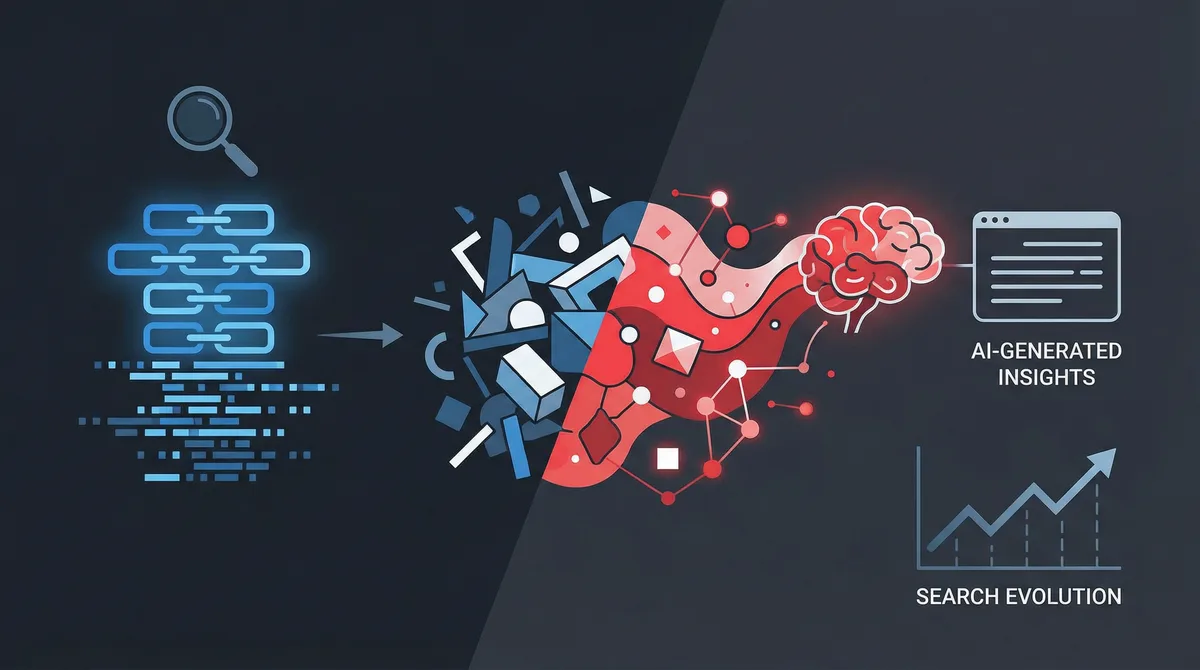
So far, digital strategy has revolved around a basic goal: securing a top position on a list of ten blue links. That era is over. Google's AI Overviews represent the most profound paradigm shift in search in over a decade. This AI-generated summary, now occupying the coveted 'Position Zero,' fundamentally alters the search engine results page (SERP) and demands an immediate evolution of our marketing strategies.
This is not a minor feature update; it is the culmination of Google's long-stated ambition to move from a search engine to an answer engine. In May 2024, Google’s Head of Search, Elizabeth Reid, articulated the vision: "Let Google do the searching for you." For marketers, this has been met with a mix of apprehension and intense curiosity. How does it work? What is the impact on traffic? And most critically, how do we earn a place within it?
This definitive guide cuts through the noise. We will deconstruct AI Overviews from a technical and strategic perspective, synthesizing data-driven analysis with practical, on-the-ground tactics. This is your comprehensive playbook for navigating and capitalizing on this new reality.
What Exactly Are AI Overviews?
Google's official documentation describes AI Overviews as a feature designed to provide a quick "snapshot of information" and help users "get the gist of a topic." Powered by a customized Gemini model integrated with Google's core Search systems, the feature doesn't just find information; it synthesizes it. When a user enters a complex, multi-faceted query—such as, "find the best drought-resistant plants for a Central Texas summer and list their water needs"—the AI does the heavy lifting, scouring multiple sources to present a single, coherent answer.
From an analytical standpoint, this marks a transition from simple keyword matching to comprehensive intent fulfillment. The AI Overview acts as a primary research assistant, drawing from web pages it deems authoritative and trustworthy. The links to these source pages are then presented within the overview, becoming the new high-value clicks.
Key Characteristics of AI Overviews:
Synthesized Answers: They combine information from multiple web pages into a single, cohesive narrative.
Complex Query Focus: They are more likely to appear for longer, conversational, or multi-faceted search queries that require analysis from several sources.
Source Citations: They include links to the web pages used to generate the summary. Earning one of these citations is the primary goal.
Dynamic Generation: The content of an overview is not static; it can change as Google's AI finds new or better information.
The Double-Edged Sword: Analyzing the Impact on Business
For any business with an online presence, AI Overviews are a classic double-edged sword. Understanding both the potential threats and the immense opportunities is crucial for building a winning strategy.
The Threat: The Zero-Click Future and Brand Dilution
Traffic Cannibalization: The primary risk is the rise of the "zero-click search." If a user's question is answered directly in the overview, their need to click through to your website is diminished. This could lead to a significant decline in traffic for content that answers simple, factual questions.
Obsolescence of Traditional Metrics: Standard click-through rate (CTR) models are becoming obsolete. A #1 ranking below an AI Overview may yield significantly less traffic than it did previously, turning a key performance indicator into a vanity metric.
Loss of Brand Control: When your content is synthesized into a larger summary, you lose control over your brand's voice and message. You become a citation rather than a destination, making it harder to build a customer relationship.
The Opportunity: Becoming Google's Chosen Authority
While the threats are real, the opportunity is immense. Getting your business cited in an AI Overview is the most powerful endorsement Google can offer.
Unparalleled Authority Signal: Being featured as a source is the ultimate stamp of approval. It tells both Google and users that you are a definitive, trustworthy expert on that topic, creating a halo effect for your entire brand.
Access to High-Intent Users: AI Overviews are most often triggered by complex, long-tail queries. These users are not casual browsers; they have a specific problem and are often deep in the consideration phase of their buying journey. A click from an overview signifies a user seeking deeper information beyond the summary, making it a highly qualified lead.
A New Competitive Frontier: Big, legacy companies are often slow to adapt their content strategies. Nimble businesses can pivot quickly to create content specifically designed for AI consumption, leapfrogging competitors who are still playing by the old SEO rules.
The Definitive Playbook: How to Secure AI Overview Visibility
Optimizing for a generative AI system requires a deeper focus on content quality, structure, and trustworthiness. This four-step, data-driven plan provides the most effective path toward being featured.
Step 1: Solidify Your Foundational Authority with E-E-A-T
If Experience, Expertise, Authoritativeness, and Trustworthiness (E-E-A-T) were important before, they are now the absolute bedrock of any successful strategy. An AI model is designed to minimize risk and will inherently favor sources that demonstrate unimpeachable credibility.
Demonstrate First-Hand Experience: Show, don't just tell. Use phrases like "In our testing," and "From our experience as practitioners." A plumber should create content detailing how they solved a tricky issue, with photos. Share unique data, case studies, and years of hands-on knowledge.
Showcase Expertise: Ensure the authors of your content are clearly identified with credentials, detailed bios, and links to professional profiles. This provides explicit signals of expertise.
Build Authoritativeness: Your reputation is paramount. Link out to academic studies and industry reports. Get mentioned in news outlets. Encourage reviews on your Google Business Profile. These external signals validate your authority.
Guarantee Trustworthiness: Be transparent. Have a clear 'About Us' page that tells your story. Make contact information easy to find. Rigorously fact-check every claim, as inaccuracy is the fastest way to be disqualified as a source.
Step 2: Engineer Content for AI Consumption
Your content must be easily parsable by Google's Gemini model. This requires a shift from a keyword-centric to a topic-centric approach, structuring content to directly and comprehensively answer complex user problems.
Answer the Entire Question: Structure articles around a central user problem. For example, instead of targeting "digital marketing KPIs," create a comprehensive guide titled, "How to Select, Track, and Report on Digital Marketing KPIs for an E-commerce Business." Use clear, descriptive headings (H1, H2, H3) to break the topic down logically.
Create Question-Oriented Content: Build out dedicated FAQ pages for your business and services. Start sections of your content with a direct, concise answer to a potential question before elaborating (the "inverted pyramid" style of writing).
Build Topic Clusters: Develop a content architecture with a central "pillar" page covering a broad topic, linked to multiple "cluster" pages that delve into specific sub-topics. This demonstrates comprehensive coverage and authority to Google.
Step 3: Speak the Machine's Language with Structured Data
Structured data (Schema markup) is code you add to your website to explicitly tell search engines what your content is about. For an AI looking to quickly synthesize information, this is a goldmine. It is no longer optional.
Prioritize Key Schema Types:
`LocalBusiness`: Crucial for any business with a physical location or service area. Clearly labels your name, address, phone number (NAP), and hours.
`FAQPage`: Mark up your question-and-answer sections. This explicitly tells Google, "This is a question, and here is its answer," making it incredibly easy for the AI to source.
`HowTo`: Structure your step-by-step guides.
`Article` (with `author` and `publisher` properties): Clearly define who wrote and published the content to reinforce E-E-A-T.
Actionable Advice: You don't need to be a coder. Use Google's free Structured Data Markup Helper to generate the code for you. Start with your homepage (`LocalBusiness`) and your most important service or content pages (`FAQPage`, `HowTo`).
Step 4: Leverage Niche and Local Expertise
This is the secret weapon for small and specialized businesses. National brands cannot compete with a deep understanding of a specific niche or local community. The AI needs reliable, granular data, and you can be that source.
Optimize Your Google Business Profile (GBP): Your GBP is arguably your most important local asset. Keep it meticulously updated. Actively solicit and respond to reviews. Use the Q&A feature to pre-emptively answer common local questions.
Create Hyper-Local Content: Write content that is undeniably local and specific. A landscaping company in Austin writing about "Drought-Resistant Plants for a Central Texas Summer" creates content a national brand never could. Answer questions related to your city's regulations, climate, and community.
A New Measurement Framework for the AI-Driven SERP
The old rules of measurement no longer apply. Traditional rank tracking is insufficient. We must evolve our analytics to capture a more nuanced view of performance in an AI-driven SERP.
Proposed KPIs for the AI Overview Era:
AI Overview Citation Rate: What percentage of your target queries generate an AI Overview, and in what percentage of those is your domain cited? This is the new primary KPI for top-of-funnel content.
Branded Mentions within Overviews: Track how often your brand name appears in AI-generated text, even without a direct link. This is a measure of brand authority.
SERP Feature Visibility: Use tools that go beyond rank to show your overall visibility across all SERP features—AI Overviews, People Also Ask, Video Carousels, etc. The goal is to maximize your SERP real estate.
Core Business Metrics: Ultimately, the goal is not clicks; it's customers. Tie your content efforts back to tangible business results. Are your phone calls, form submissions, and in-store visits increasing?
Conclusion: Adapting to the New Search Intelligence
Google's AI Overviews represent a foundational rewiring of the relationship between users, search engines, and content creators. This is not a trend to wait out; it is the new reality. The path forward is not about finding short-term hacks but a strategic, sustained commitment to creating the most helpful, authoritative, and well-structured content on the internet. The principles that make content valuable to a human—clarity, deep expertise, and trustworthiness—are precisely the principles that make it valuable to an AI designed to serve that human.
The future of organic search belongs to those who provide the definitive answers that both users and Google's AI are looking for. By being more helpful, more authentic, and more authoritative, this is a game you can win.
The Future of Search: Embracing Change
As we look ahead, it’s clear that the landscape of digital marketing is shifting rapidly. Adapting to these changes is not just advisable; it’s essential. The rise of AI Overviews signifies a move towards a more intelligent, user-focused search experience. Embracing this change will require businesses to rethink their strategies and focus on delivering value.
Understanding User Intent
Understanding user intent is crucial in this new era. Businesses must delve deeper into what users are searching for and why. This means going beyond surface-level keywords and exploring the underlying questions that drive user behavior. By aligning content with user intent, businesses can better position themselves to be featured in AI Overviews.
The Role of Content Quality
Content quality will play a pivotal role in determining visibility in AI Overviews. High-quality, well-researched content that addresses user needs will stand out. Businesses should prioritize creating content that is not only informative but also engaging. This includes using visuals, infographics, and interactive elements to enhance the user experience.
Building Relationships with Users
Building relationships with users is more important than ever. Engaging with your audience through social media, email newsletters, and community forums can help foster trust and loyalty. When users feel connected to a brand, they are more likely to seek out its content and engage with it.
Continuous Learning and Adaptation
Finally, businesses must commit to continuous learning and adaptation. The digital landscape is ever-evolving, and staying ahead of the curve requires ongoing education and flexibility. Keeping abreast of the latest trends, tools, and technologies will empower businesses to refine their strategies and maintain a competitive edge.
In conclusion, the rise of AI Overviews is a call to action for businesses. By embracing this change and focusing on delivering value, businesses can thrive in the new search landscape. The future is bright for those willing to adapt and innovate.
How ChatGPT Atlas, Google’s AI Overviews, and Perplexity Are Changing Search
Frequently Asked Questions
What are Google AI Overviews?
Google AI Overviews are AI-generated summaries that appear at the top of Google Search results, powered by Google's Gemini model. They synthesize information from multiple web pages to provide users with a comprehensive answer to complex queries, fundamentally changing how users interact with search results.
How do AI Overviews impact traditional SEO?
AI Overviews significantly impact traditional SEO by increasing zero-click searches, where users get answers directly on the results page without clicking through to websites. This can reduce organic traffic for informational content, making it essential for businesses to adopt Generative Search Optimization (GSO) strategies to maintain visibility.
What is Generative Search Optimization (GSO)?
Generative Search Optimization (GSO) is the practice of optimizing content specifically for AI-powered search features like Google AI Overviews, ChatGPT, and Perplexity. It focuses on creating well-structured, authoritative content with proper schema markup that AI systems can easily parse and cite as a source.
Why is E-E-A-T crucial for AI Search visibility?
E-E-A-T (Experience, Expertise, Authoritativeness, Trustworthiness) is crucial because AI models are designed to minimize risk and favor sources with unimpeachable credibility.
How can businesses secure AI Overview visibility?
Businesses can secure AI Overview visibility by implementing a four-step strategy: solidifying foundational authority with E-E-A-T signals, engineering content for AI consumption, implementing structured data markup, and leveraging niche and local expertise.